
Guiding Stem Cells Step by Step: New Tool Improves Models of Pediatric Cancer Development
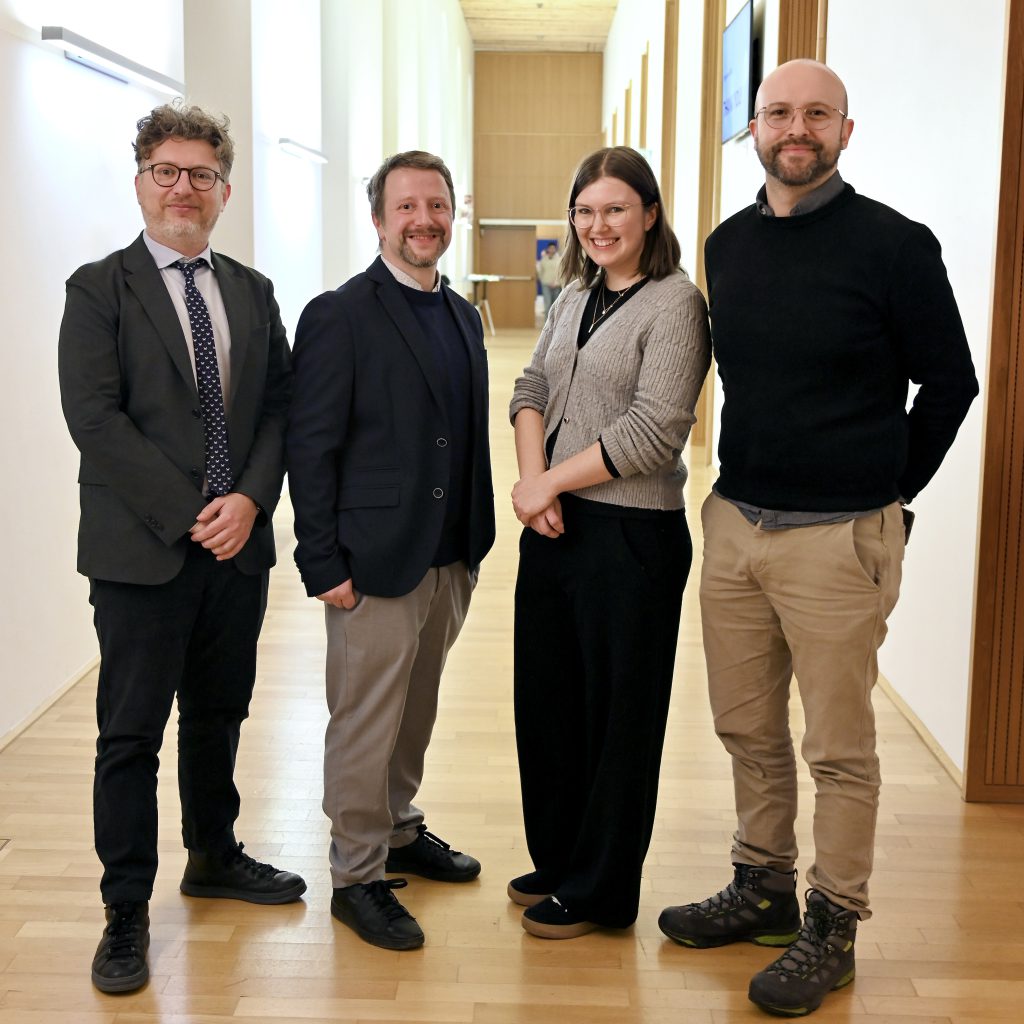
To study the molecular causes of pediatric cancer, scientists need to recreate complex developmental processes in the lab – an effort that often requires a great deal of trial and error. Scientists in the labs of Florian Halbritter and Davide Seruggia at the St. Anna Children’s Cancer Research Institute (St. Anna CCRI) have developed a new method that helps scientists craft accurate cellular models from stem cells. Their findings, published in the journal Nucleic Acids Research, establish a new strategy to improve disease modelling in pediatric cancer and could have implications in regenerative medicine.
In Simple Terms
– Creating lab models of cancer development requires taking stem cells through a long process that must be optimized step by step.
– The researchers developed a method to help them choose only the best condition at each step to make the process faster and cheaper.
– Their method could make it easier to model childhood cancer and have applications in regenerative medicine.
Pediatric cancer often begins with errors during early development, when cells fail to choose the right path and instead start forming a tumor. Understanding how genetic alterations cause these missteps is essential not only to learn how cancer develops, but also to find new treatments.
To investigate this, scientists recreate aspects of early development in the lab. They use different experimental conditions to gently guide stem cells through the stages they would normally follow as they turn into specialized cell types. But fine-tuning each step can quickly become an enormous task: different lab conditions can produce cells that look similar but behave very differently, and current methods struggle to determine how closely these lab-grown cells match real developing cells at each step.
To address this problem, a research team led by Florian Halbritter and Davide Seruggia developed a new method based on principles used to streamline tasks in computer science. The approach evaluates success early on – not just at the final stage of differentiation – helping scientists compare experimental conditions more accurately and select the best protocol to produce the desired cell type. It can even suggest improvements to make lab-grown cells more similar to cells in the body.
Machine learning concepts inspire disease modeling
Typically, researchers fine-tune a differentiation protocol – the step-by-step process that turns a stem cell into a specialized cell in the lab – by examining only the final product and measuring how similar it is to a reference cell (such as red blood cells or liver cells). But once a protocol includes several stages, it becomes increasingly demanding to understand how changes at each step affect the final result.
“The number of combinations gets exponentially larger,” explains Florian Halbritter. “With only two steps and eight experimental conditions at each step, that’s 64 different protocols to compate. With three steps, we already have 512 different combinations!“
Testing all combinations is often impossible, as time and resources are limited. To simplify the process, the team drew inspiration from a concept in machine learning known as greedy optimization. “Greedy optimization simplifies the search by looking at each intermediate step and choosing only the best condition to move forward with”, explains co-first author Luis Montano. By applying this idea, the scientists reduced the number of conditions to test, cutting down on time and costs. However, to make this work, they needed a precise way to evaluate developing cells at each stage of the protocol.
Chromatin landscape guides the path
To determine what type of cell they have at hand, scientists often rely on microscopy and flow cytometry – tools that show how cells look, but not how they function internally. “While these tools are often sufficient in other cases, they’re not precise enough to tell us how close we are to replicating normal development,” says Davide Seruggia. The team instead turned to chromatin, the genome’s structural packaging inside cells.
“Chromatin structure is essential to making a cell into what it is,” explains co-first author Sophie Müller. “At each stage of development, the cell’s chromatin – which packages the DNA – is rearranged and organized to make some genes more accessible and block others.” Using chromatin accessibility as a readout, the scientists compared lab-made cells with real developing cells to choose the best conditions at each stage. With this strategy, they established a refined protocol to produce erythroblasts, the precursors of red blood cells.
The method also pinpointed possible improvements. By examining subtle differences in chromatin between experimental cells and erythroblasts in the body, the team identified tweaks that made the models even more accurate.
From pediatric cancer modelling to regenerative medicine
The team’s findings introduce a new strategy to improve cellular models of pediatric cancer development, which allow researchers to better understand disease origins and design more effective treatments. But the implications extend well beyond cancer research. By improving how specific cell types are generated in the lab, the method may empower new regenerative medicine approaches, where lab-grown cells could help repair tissue damaged by stroke, heart attack, or other injuries.
“Our strategy is easy to implement in most labs around the world,” Halbritter says. “We hope it will help other scientists optimize their processes so they can focus on what’s really important: understanding disease and developing new therapies”.
Publication
Montano-Gutierrez, L.F., Müller, S., Kutschat, A.P., Adameyko, I., Seruggia, D., Halbritter, F. Directing stem cell differentiation by chromatin state approximation. Nucleic Acids Res. (2026). https://doi.org/10.1093/nar/gkag124