
A SAGA of instability: Without scaffold, a key driver of childhood leukemia falls apart
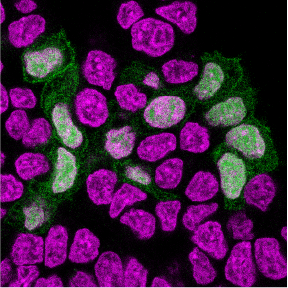
(Vienna, 20.04.2026) – Researchers in the Seruggia group at St. Anna Children’s Cancer Research Institute (St. Anna CCRI) and the CeMM Research Center for Molecular Medicine have uncovered a new way to tackle acute myeloid leukemia (AML) cells in children: Instead of directly targeting the cancer-driving protein KAT2A – which can be compensated by a closely-related counterpart – the scientists destabilized it’s scaffold in the so-called SAGAcomplex. This indirect approach causes KAT2A to break down, bringing the proliferation of AML cells to a halt. Published in Nature Communications, the approach could pave the way for new treatments for children with leukemia.
In Simple Terms
– The protein KAT2A controls gene expression and is a weak spot in pediatric leukemia cells, but targeting it directly doesn’t work.
– The scientists targeted the protein scaffold supporting KAT2A and triggered a molecular domino effect that led to KAT2A degradation.
Acute myeloid leukemia, or AML, is one of the most aggressive pediatric blood cancers. Survival has improved markedly over recent decades, but relapse remains a defining challenge: most occur within a year of diagnosis, and long-term survival after relapse is still poor. This has intensified the search for new therapies that do not simply attack leukemia cells head-on, but exploit the hidden molecular weaknesses on which they depend.
Therapies that can regulate gene expression in cancer cells hold great potential for treatment. However, this is challenging because regulatory mechanisms are often redundant and can quickly adapt and compensate to maintain cell survival.
KAT2A—an enzyme regulating DNA control regions to promote gene activation—has long been considered a weak spot in AML cells. Yet, when KAT2A is eliminated, a similar protein called KAT2B can take over its functions, making this vulnerability surprisingly resilient. To overcome this challenge, researchers in the Seruggia lab aimed to develop indirect mechanisms to tackle KAT2A from a different angle.
A molecular domino effect
To regulate gene expression, KAT2A does not work alone. It is part of SAGA, a large complex made up of about twenty different proteins with various gene regulatory roles. Some of these proteins act directly on DNA, while others provide structural support.
Knocking out one of these scaffold proteins triggered a domino effect that caused the entire SAGA complex to fall apart. Without this support, KAT2A could no longer perform its functions, effectively curbing the growth of AML cells. Importantly, because this approach targets the SAGA scaffold rather than KAT2A itself, KAT2B cannot compensate, as it also requires an intact SAGA complex. This workaround allows researchers for the first time to reduce KAT2A activity effectively in AML cells.
A two-pronged approach to eliminate KAT2A
Surprisingly, destabilizing the SAGA complex not only blocked KAT2A from acting on the DNA. Without their scaffold, free KAT2A proteins were rapidly degraded by the cell’s quality control system, which removes proteins not properly integrated into complexes to prevent cellular damage. In two leukemia cell models, free KAT2A proteins were eliminated within 24 hours, further reducing its activity.
This study demonstrates that targeting multi-protein complexes, rather than individual proteins, could offer a promising strategy for leukemia therapy, explains Davide Seruggia, corresponding author of the study. “Our approach not only illustrates how cells normally eliminate the solitary form of KAT2A, but also suggests other components of the SAGA complex as potential targets of therapy in different leukemia types. In addition, targeting critical structural proteins in other protein complexes might have similar effects, and could help develop novel therapeutic approaches for different types of cancer.”
These results highlight the therapeutic potential of this indirect approach: Collapsing key protein scaffolds can expose cancer vulnerabilities, and may pave the way for novel treatments in pediatric leukemia.
Publication
Batty, P., Beneder, H., Schätz, C., Onea, G., Zaczek, M., Kutschat, A.P., Abele, M., Müller, S., Superti-Furga, G., Winter, G.E., Seruggia, D. Disruption of the SAGA CORE triggers collateral degradation of KAT2A. Nat Commun. (2026). https://doi.org/10.1038/s41467-026-71613-7
Funding: This work was supported by the Austrian Science Fund (FWF), the European Research Council (ERC), the Austrian Academy of Sciences, the Boehringer Ingelheim Foundation, Cancer Research UK, the Institut National du Cancer, the Children Cancer Free Foundation, and the Vienna Science and Technology Fund (WWTF).